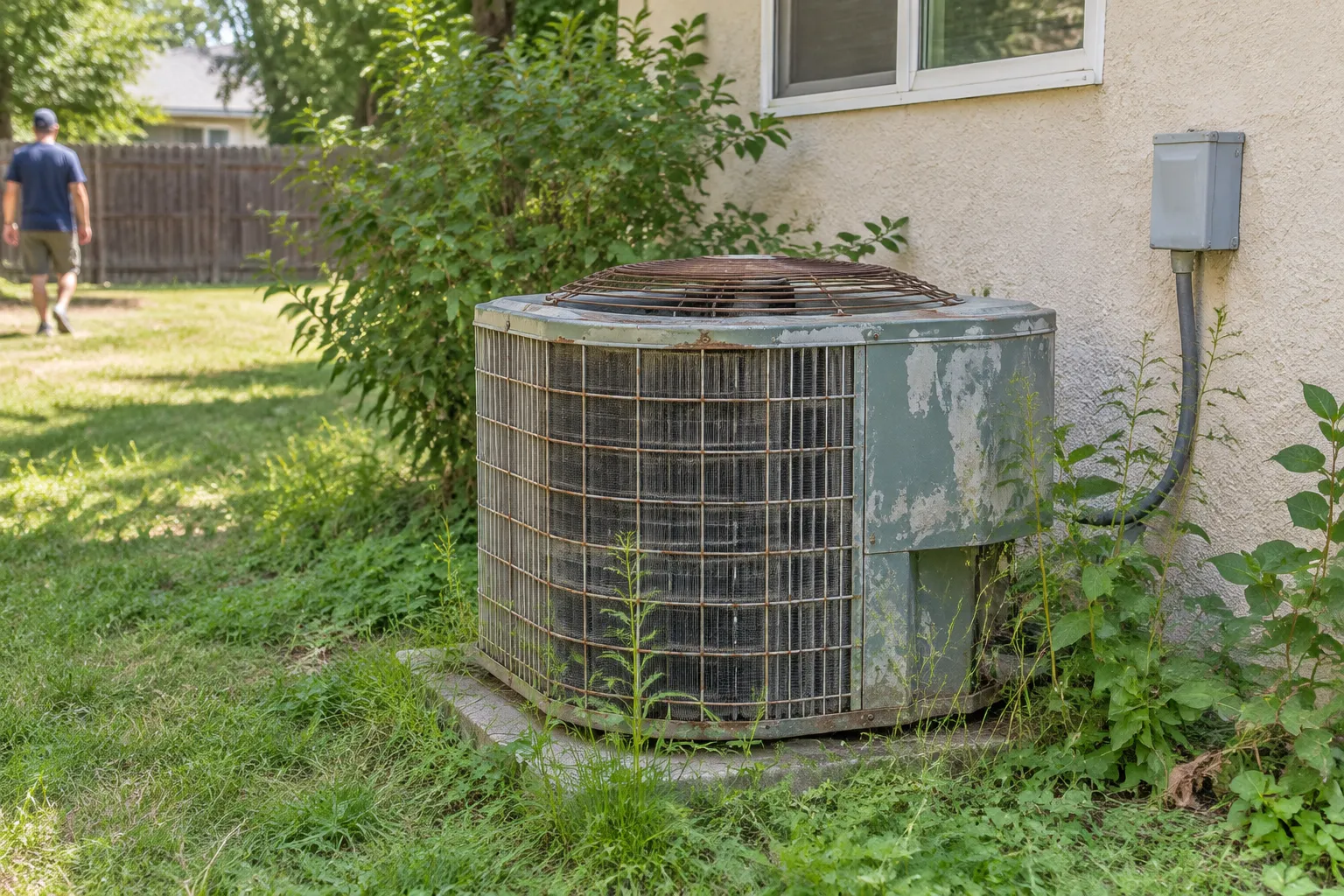
There is no single lifespan for an air conditioner. How long yours lasts depends on the quality of the unit, how well it was installed, how much it runs and whether it has been looked after, and a local specialist can tell you more after reading the nameplate on your unit. Sacramento's July average high is about 92.6 F (NOAA 1991-2020 normals, Sacramento Executive Airport), so a cooling system there runs a lot in summer. Maintenance helps, and if your unit is already struggling, read about AC repair in Sacramento first. This page also covers replacing a unit and what to ask in an estimate. For the full price picture, see the cost of replacing an HVAC system.
What is the average lifespan of an AC unit?
No official source gives one lifespan for a central AC, and published guides disagree, so this page does not quote one. ENERGY STAR does not give a single number either, but says that for equipment more than 10 years old you should consider replacement, and have a professional evaluate it first. Lifespan depends on the unit's quality, how it was installed, how much it runs and whether it has been maintained.
By type, the only figures this page can source are the Department of Energy's cost-analysis assumptions:
| System | DOE assumption |
|---|---|
| Residential air-source heat pump | 15-year average life |
| Residential furnace | 21-year average lifetime |
These are averages DOE uses in its cost calculations, not promises. A well-kept unit can pass them, and a neglected one can fall short. For any other type of system, such as a central AC, a mini split or a window unit, ask the specialist or check the maker's manual.
How long does an outside AC unit last compared with the whole system?
The outdoor unit holds the compressor and condenser, and it is usually the part that decides when you replace. The indoor coil, ducts and thermostat can last longer or fail sooner. A system is usually replaced as a whole, since the indoor coil and outdoor unit work as a matched pair. Parts can be replaced earlier, such as a fan motor or capacitor.
What tends to wear out first:
- Capacitors and contactors. Small parts that fail often and cost little compared with the unit.
- Fan motors. They run for years but can fail in heat.
- Refrigerant lines and coils. Leaks can appear as the system ages.
- The compressor. The costly part. When it fails on an old unit, replacing the whole system is often the better deal.
If the outdoor unit is failing and the indoor part is fine, ask a local specialist whether a matched replacement is needed. Some systems accept a new outdoor unit, and others do not.
What affects how long my air conditioner lasts?
Climate and use, maintenance, installation quality and size are the big four. ENERGY STAR notes that improper installation can reduce efficiency by up to 30 percent and may shorten equipment life. A unit that runs more hours has more wear, so ask the specialist what to expect for your home.
How to give your system a better chance:
- Change filters. ENERGY STAR says to check them monthly. A dirty filter can shorten equipment life.
- Keep coils clean. ENERGY STAR says dirty coils make the system run longer, which is more wear for the same cooling.
- Book a yearly tune-up. ENERGY STAR suggests checking cooling in spring and heating in fall, because contractors are busy in summer and winter. See HVAC maintenance.
- Fix small problems early. A weak capacitor or a small leak can damage other parts.
- Keep the outdoor unit clear. Leave space around it, and clear leaves and debris.
- Make sure the size is right. An oversized system can struggle, and the Department of Energy names oversizing among the causes of lost efficiency. Ask how the specialist sizes it.
- Keep ducts sealed. See HVAC ductwork repair.
What are the signs it is time to replace my AC?
Common signs are frequent repairs, a system with mechanical problems that is getting old, rising energy bills, uneven cooling, loud or strange noises, higher indoor humidity, warm air from the vents, and refrigerant or water leaks. One sign alone may not mean replacement, but several together usually do.
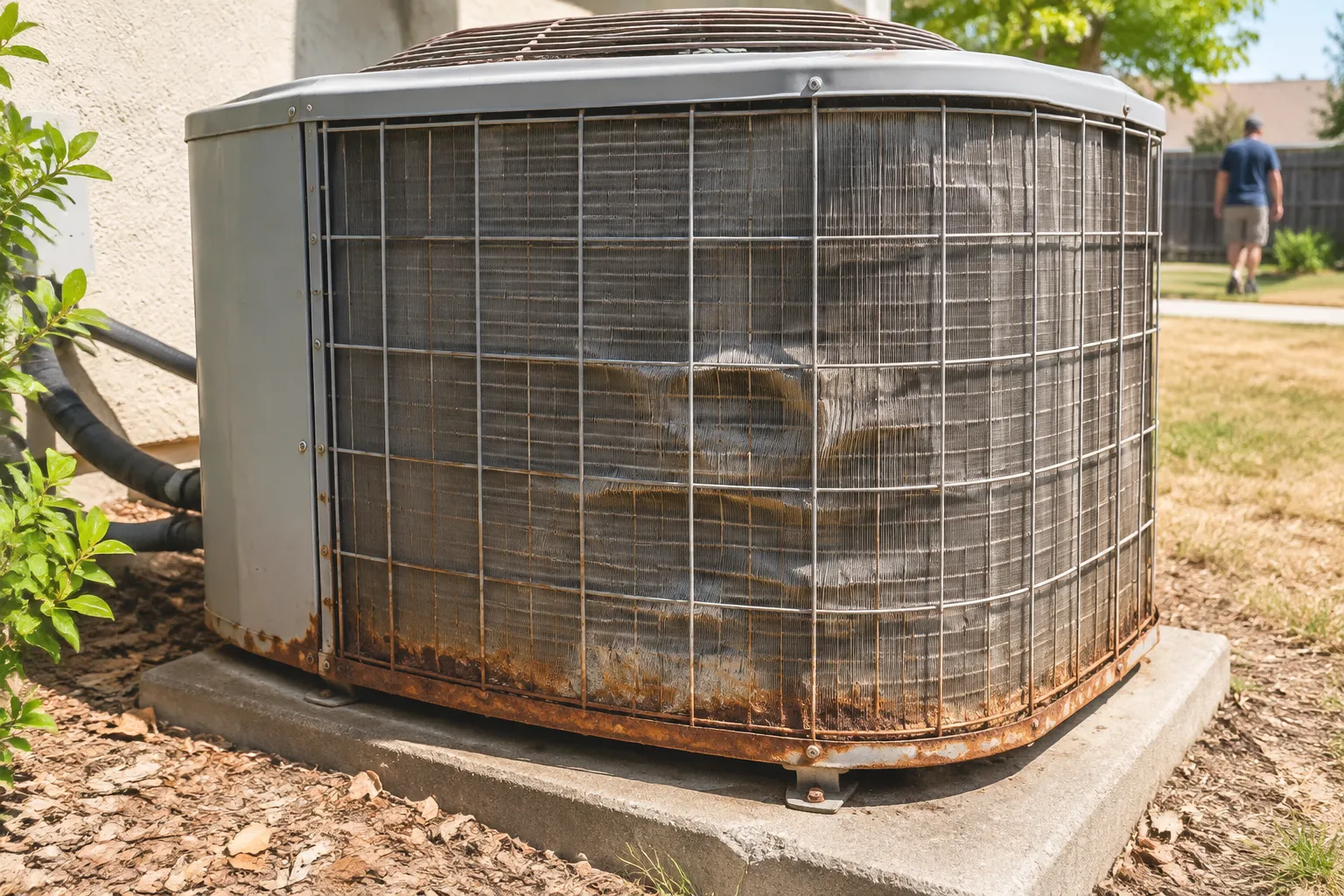
A simple way to weigh it is the rule of thumb many guides use: multiply the repair quote by the unit's age. If the answer is $5,000 or more, replacing is usually the better choice. A $700 repair on a 9-year-old unit gives 6,300, so it points toward replacing. It is a guide only.
Before you decide, ask yourself:
- Is the system over 10 years old and needing repeated repairs?
- Is the repair quote a large share of the price of a new system?
- Has a specialist told you the compressor, coil or refrigerant lines are failing?
- Is your energy use up while comfort is down?
For warm-air problems specifically, see AC blowing warm air. ENERGY STAR also advises fixing major duct and air leak problems first, since those can be the real source of trouble rather than the equipment.
How much does it cost to replace an AC unit?
There is no sourced price for replacing an AC alone, so ask for a written quote. Replacing a whole system, furnace and AC together, costs $8,000 to $20,000 in Fixr's guide. A heat pump installation is $5,000 to $15,000, and a typical ductless mini split is $4,577 to $8,328. A local specialist gives an estimate after seeing your home.
What changes the price of AC installation:
- Size. Larger homes need larger systems.
- Efficiency rating. A higher SEER2 rating costs more up front. See our guide to AC vs heat pump.
- Ductwork. New or modified ducts add cost.
- Labor and access. A tight attic or a rooftop unit takes longer to install.
- Electrical work and permits. Ask whether a permit applies to your job.
Ask about financing options if the total is a stretch. Compare at least two written estimates, and check that each covers the same equipment, the same installed scope and the same extras. For a repair instead of a replacement, see the AC repair cost guide.
Questions people ask
What is the lifespan of a house AC unit?
No official source gives one number, and published guides disagree, so ask a local specialist about your unit. The Department of Energy assumes a 15-year average life for a residential air-source heat pump. Climate, maintenance and installation all matter, and yearly service and clean filters help a system last.
How long does a window AC unit last?
No source this site has checked gives a reliable lifespan for a window unit, so check the maker's manual or ask a specialist. Clean the filter often and store the unit properly in winter to help it last. Window units are not covered by the central AC work described elsewhere on this site.
What is the average lifespan of a home HVAC system?
It depends on the part, so ask a specialist. The Department of Energy assumes a 21-year average life for a residential furnace and 15 years for an air-source heat pump. Ducts can last longer if kept sealed. Because the parts age differently, many homes replace the AC and furnace at different times.
What is the average lifespan of a home gas furnace?
The Department of Energy's furnace cost analysis assumes an average residential furnace lifetime of 21 years. Keep the filter clean and book a yearly check. Because gas furnaces can release carbon monoxide when something fails, an old furnace should be checked by a local specialist. See furnace carbon monoxide for safety steps.
How long does it take a professional to install a furnace?
It varies with the furnace, the ducts and how easy the space is to reach, so no single number fits. Ask the specialist for an estimate of the time when you request a quote, and ask whether the price includes removal of the old furnace and setting the thermostat. C-20 is the CSLB classification for warm-air heating, ventilating and air-conditioning work. Ask any specialist for their license number and check it on the CSLB License Check page.
How long does an HVAC repair take?
It depends on the fault and whether the part is on hand. A simple repair can be done in one visit, while a compressor, coil or refrigerant leak can take longer. A local specialist can give you a time estimate with a written quote. Start from our home page to see the repair guides.
Where these facts come from
- Fixr, HVAC installation cost article
- Fixr, heat pump installation cost
- Fixr, ductless air conditioner installation cost
- US Department of Energy FEMP, residential air-source heat pumps
- US Department of Energy FEMP, residential furnaces
- ENERGY STAR, heating and cooling at home
- ENERGY STAR, maintenance checklist
- NOAA 1991-2020 climate normals, Sacramento Executive Airport
Page updated