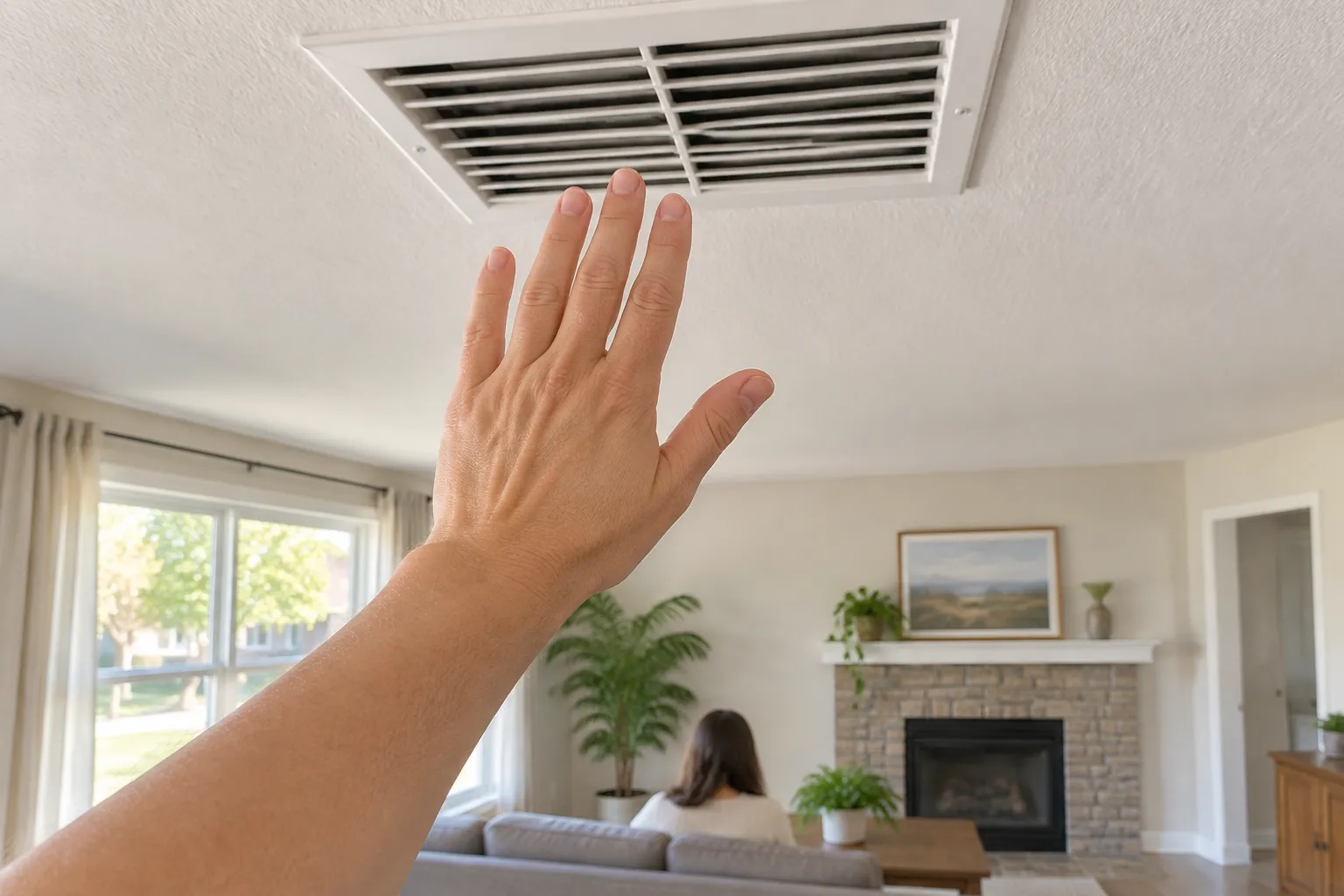
Warm air from your air conditioner usually comes from one of a few causes: the thermostat is set to the wrong mode or fan setting, the filter is clogged, the outdoor unit is not running, the coil is dirty or frozen, or the system has lost refrigerant. You can safely check the first three. The rest need a local specialist. If it is a hot day, switch the system off if it is not cooling at all, since running it can stress it. This page, a companion to our AC repair page, walks through what to check, which causes cost more, and when to ask for quotes.
Why is my AC blowing warm air only?
Start at the thermostat, then the filter, then the outdoor unit. Warm air means the air conditioning system is moving air but not removing heat from it. A wrong thermostat setting, a clogged filter, a tripped breaker, a dirty or frozen coil, or a refrigerant leak are the usual causes. The first three are safe to check yourself.
A short order of checks:
- Thermostat. Make sure the mode is set to cool and the set temperature is below the room temperature. If the fan is set to "on" instead of "auto," the fan runs even when the cooling stops and blows warm air between cycles. Auto is normal for most homes.
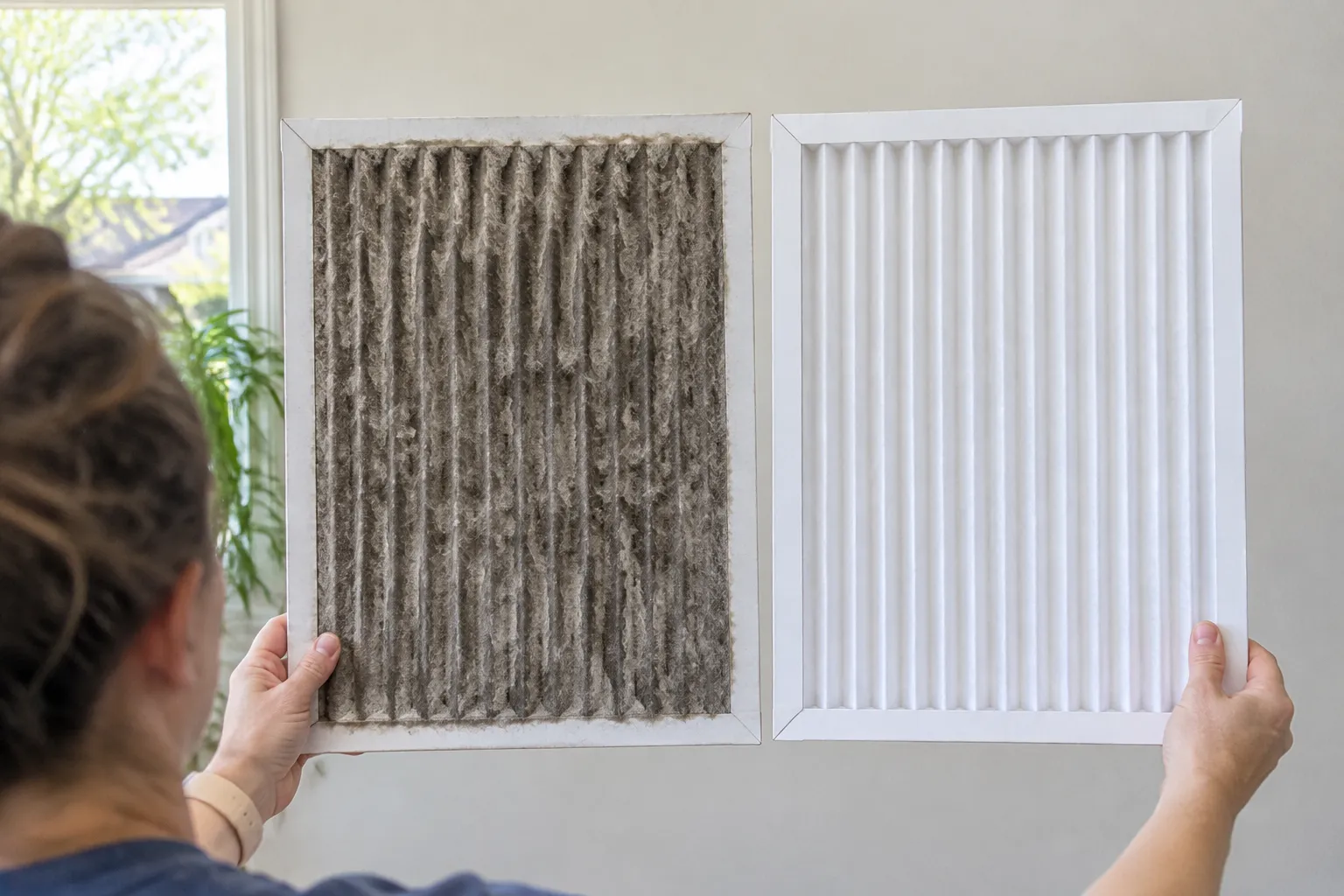
- Filter. ENERGY STAR advises checking or changing the filter monthly. A dirty filter slows airflow and can cause early system failure.
- Vents. Make sure supply vents and return grilles are open and not blocked by furniture. Keep supply vents and return grilles clear so air can move.
- Breaker and switches. Check the breaker for the AC and the power switch near the indoor unit. Reset a breaker once. If it trips again, stop.
- Outdoor unit. With the system on, see whether the outdoor fan is spinning and whether leaves or debris block the unit. Do not open the unit. Clearing loose debris from the outside is fine, with the power off.
If these do not change anything, it is time to call a specialist. The fix may be more than the settings.
What are the common causes of an AC unit blowing warm air?
Beyond the simple checks, the causes you cannot fix yourself include a failed capacitor or contactor, a dirty evaporator or condenser coil, a frozen coil, low refrigerant from a leak, a failing compressor, and leaky ducts. Each has a different cost. Worse, some have the same symptom, so a specialist has to test to know which.
| Cause | What you may notice | Who fixes it |
|---|---|---|
| Wrong thermostat setting | Warm air only when the fan is on | You |
| Clogged filter | Weak airflow at all vents | You |
| Tripped breaker | Outdoor unit silent | You can reset once, then specialist |
| Failed capacitor or contactor | Fan runs, outdoor unit hums or will not start | Specialist |
| Dirty coils | Cooling gets worse over weeks | Specialist |
| Frozen coil | Ice on the indoor unit or lines, weak airflow | Specialist |
| Low refrigerant | Warm air, ice, hissing | Specialist |
| Failing compressor | Outdoor unit runs but no cooling, or trips breaker | Specialist |
ENERGY STAR says dirty evaporator and condenser coils make the system run longer, and that too much or too little refrigerant makes a system less efficient. A frozen AC system is a common cause of warm air: when the coil ices over, airflow stops and the air that does come out is not cooled. Our guide to an AC running but not cooling covers more causes.
Refrigerant is not a topping-up job for homeowners. Refrigerant rules are set federally by the EPA, and under its sales restriction only technicians with Section 608 certification, or employers of them, can buy refrigerant for stationary equipment. A system that is low on refrigerant has a leak, and a specialist should find and fix it. See AC recharge cost for typical prices.
Should you turn off your AC if it is not cooling?
Yes, if it blows warm air and you cannot find a simple cause, switch the system off at the thermostat and leave it off until a specialist checks it. Running a system with a frozen coil, a failing compressor or low refrigerant can make the damage worse. If you see ice, leave cooling off and tell the specialist when you call.
Turn it off right away and call a local specialist if you notice:
- A burning smell, smoke or sparks. Leave the area and call 911 if there is any sign of fire.
- A loud grinding or banging from the outdoor unit.
- The breaker tripping every time the system starts.
- Water pouring from the indoor unit. See AC water leaking.
Never open the cabinet or touch the wires, capacitor or refrigerant lines. Capacitors and wiring can hold a dangerous electrical charge, and refrigerant lines are under pressure. If you smell gas, leave and call your gas utility or 911.
What is the 3 minute rule for AC?
The 3 minute rule says to wait about three minutes after your AC switches off before turning it back on. The pause lets pressure in the system balance, so the compressor is not trying to start against high pressure. Many modern systems build in a delay of a few minutes. If you keep switching the thermostat, you may be causing warm air for a few minutes yourself.
What this means in practice:
- If you changed the temperature setting and the AC did not start straight away, wait a few minutes before assuming it is broken.
- If it keeps shutting off and starting again every few minutes, that is short cycling, a separate problem that needs a specialist.
- Check your owner's manual for the maker's guidance on your model.
This rule is a general guideline from air conditioner makers and trade guides, and exact delays vary by system.
What is the $5000 rule for AC?
It is a rule of thumb for deciding between repairing and replacing: multiply the repair cost by the unit's age in years. If the result is $5,000 or more, replacement is usually the better choice. A $600 repair on a 10-year-old system gives 6,000, which points to replacement. It is a guide, not a law, and a specialist can give you a better view for your system.
The rule is useful when warm air comes with a costly repair, such as a compressor. Before you decide, compare:
- The repair quote, in writing.
- The age and condition of the whole system.
- The cost of a new system. See the cost of replacing an HVAC system.
- How long you plan to stay in the house.
Our guide on how long an AC lasts helps you place your unit on that timeline. For repair prices by job, see the AC repair cost guide.
How much does it cost to fix an AC blowing warm air?
The cost depends on the cause, which is why a specialist has to diagnose it first. A simple fix, such as a thermostat or filter, costs little or nothing. Fixr puts a typical central AC repair at $250 to $700, a capacitor at $100 to $400, a refrigerant recharge at $100 to $600, a leak repair at $200 to $1,500 and a compressor at $600 to $3,000. Ask local specialists for written quotes and compare them.
What drives the price:
- The part that failed. A capacitor costs far less than a compressor.
- Whether refrigerant is involved. Finding and repairing a leak adds time.
- Age and model of the system. Older systems can have parts that are harder to get.
- Access. A rooftop or tight attic unit takes longer.
- Timing. Hot-weather emergencies can cost more. See AC emergency repair.
Questions people ask
How cool should my house be if it is 100 outside?
On a very hot day, an AC may not bring a house down to a low setting. Sacramento's July average high is about 92.6 F (NOAA 1991-2020 normals, Sacramento Executive Airport). Set the thermostat to a comfortable temperature and give the system time. If the house is much warmer than usual, or the air from the vents is warm, have the system checked by a local specialist.
How do I reset my air conditioner?
Turn the thermostat to off, switch off the AC breaker for a minute, then switch it back on once and wait several minutes before setting the thermostat to cool. Some units have a reset button, but locations differ by brand, and it is not for you to open the cabinet. If the breaker trips again or the unit still blows warm air, call a local specialist.
Why would a ductless mini split blow warm air?
Check that the remote or app is set to cool and not heat or fan, that the temperature is below the room temperature, and that the filter is clean. If those are fine, the cause may be refrigerant, a sensor or a control fault, which a specialist should check. See our mini split AC page for more.
Can warm air from the vents be a duct problem?
Yes. Leaking or disconnected ducts can lose cooled air in the attic or crawl space, so rooms get warm air or weak airflow. If some rooms are fine and others warm, the ducts are a suspect. See HVAC ductwork repair.
What should I ask a specialist before they start?
C-20 is the CSLB classification for warm-air heating, ventilating and air-conditioning work. Ask any specialist for their license number and check it on the CSLB License Check page. Ask for a written quote that names the fault, the parts and the labor, and ask whether the price changes if they find more. Our home page lists other services if you need them.
Where these facts come from
- ENERGY STAR, maintenance checklist
- ENERGY STAR, heating and cooling at home
- US Department of Energy FEMP, central air conditioners
- EPA, refrigerant sales restriction (Section 608)
- Fixr, air conditioner repair cost guide
- NOAA 1991-2020 climate normals, Sacramento Executive Airport
Page updated